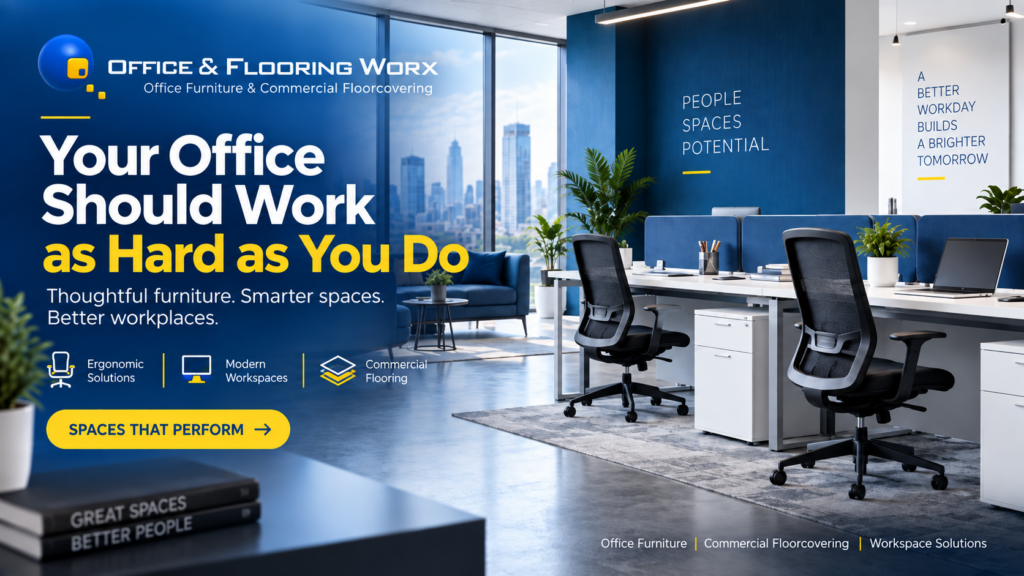
How to Build a Workspace That Supports Your Business Your business is working hard.
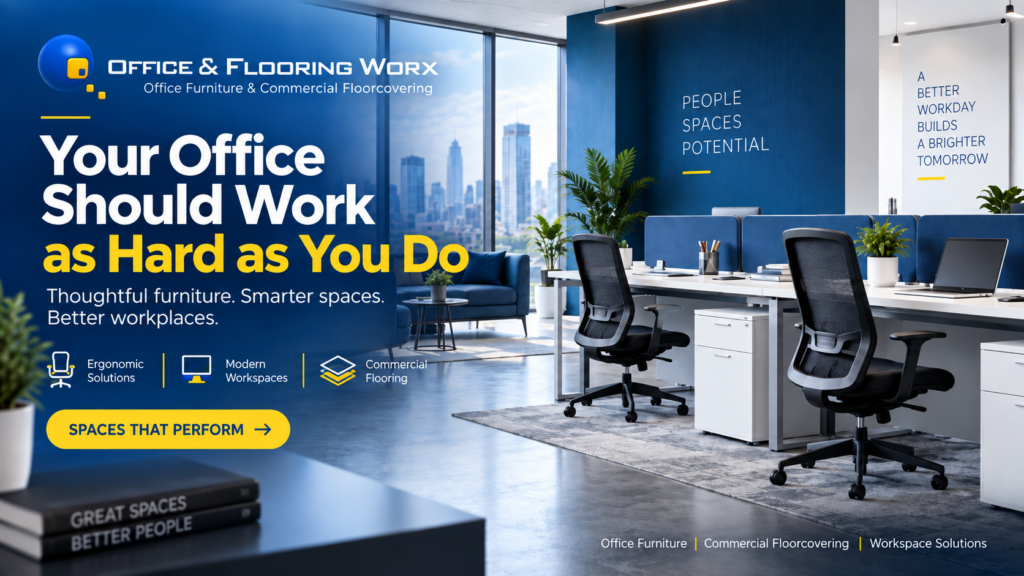
Your employees are answering emails, meeting deadlines, talking with customers, managing projects, making sales, solving problems, and finding ways to keep the business moving forward.
But here’s a question many Tampa Bay business owners don’t ask often enough:
Is your office working just as hard?
Because your office is more than four walls, desks, chairs, and conference rooms.
Your workspace is an operational tool.
When it’s designed correctly, it can help your employees collaborate, concentrate, communicate, and get more done.
When it’s poorly planned, outdated, overcrowded, or simply no longer fits the way your business operates, your office can quietly create problems every single day.
Employees work around the furniture.
Departments compete for space.
Conference rooms become storage rooms.
People take calls in hallways.
Unused areas sit empty while other parts of the office feel cramped.
And eventually, someone says:
“We need more desks.”
But do you?
Maybe.
Or maybe your business doesn’t need more furniture.
Maybe it needs a better workspace strategy.
That’s where the difference between buying office furniture and planning an office becomes extremely important.
Your Office Is Part of Your Business Infrastructure
Businesses spend thousands of dollars on computers, software, telecommunications, vehicles, equipment, advertising, and technology.
Yet the physical workspace is sometimes treated as an afterthought.
A business grows from 10 employees to 20 and the response is:
“Where can we squeeze another workstation?”
A department adds three people and suddenly someone is working at a conference table.
A company moves into a larger office but doesn’t properly plan the layout, resulting in large areas that are rarely used and other areas that are overcrowded.
These aren’t necessarily furniture problems.
They’re space-planning problems.
Your office should be designed around the way your employees actually work.
That means looking at workflow, communication, privacy, collaboration, storage, technology, traffic patterns, employee comfort, and future growth.
When those pieces work together, your office becomes an asset instead of an obstacle.
7 Signs Your Office Isn’t Working as Hard as Your Business
Not sure whether your workspace is helping or hurting your business?
Here are seven signs it’s probably time to take a closer look.
1. You’re Constantly Running Out of Space
This is one of the most obvious warning signs.
You hire another employee, and suddenly you’re asking:
“Where are we going to put them?”
Then you move a desk.
Someone loses access to a filing cabinet.
Another employee moves into a conference room.
Eventually, your office starts feeling like a game of Tetris.
The problem isn’t always that you don’t have enough square footage.
Sometimes the problem is that the existing space isn’t being used efficiently.
A professional space plan can identify opportunities to improve workstation placement, traffic flow, storage, collaboration areas, and other functions without automatically requiring you to move into a larger building.
2. Employees Are Working Around the Furniture
Your furniture should support your employees’ work.
It shouldn’t dictate how they work.
Look around your office.
People are constantly moving chairs because walkways are too tight?
Due to insufficient storage, supplies are stacked under desks.
Are people using conference rooms for individual work because they don’t have appropriate spaces?
Are desks positioned in ways that make communication difficult?
Are employees running extension cords across walkways?
These may seem like small annoyances.
But small inefficiencies repeated every day become expensive over time.
Your employees shouldn’t have to fight their workspace just to do their jobs.
3. Your Conference Room Is Always Occupied—or Never Used
Conference rooms are another good indicator of whether your office layout is working.
Some businesses have one conference room that is booked constantly.
Others have conference rooms that sit empty most of the day.
Both situations can indicate a planning problem.
Modern workplaces often need more than one type of meeting environment.
You may need:
- A formal conference room
- Small meeting spaces
- Private offices for confidential conversations
- Informal collaboration areas
- Quick touchdown spaces
- Quiet areas for focused work
The goal isn’t necessarily to build more conference rooms.
The goal is to provide the right types of spaces for the way your employees actually work.
4. Your Employees Complain About Their Chairs
Let’s talk about the piece of office furniture employees interact with for hours every day:
Their chair.
If employees are constantly adjusting, replacing, or complaining about their chairs, it’s worth paying attention.
A quality ergonomic task chair should provide appropriate support and adaptability for the user and the work being performed.
That doesn’t mean every employee needs the same chair.
Different employees have different body types, working styles, tasks, and preferences.
More importantly, your chair strategy should be part of a larger ergonomic approach that considers the entire workstation.
Desk height.
Monitor placement.
Keyboard and mouse positioning.
Lighting.
Workspace organization.
And the chair itself.
Your employees are one of your company’s biggest investments.
Their workspace shouldn’t be an afterthought.
5. Your Office Has Plenty of Space—but It Still Feels Crowded
This is one of the most frustrating office problems.
You know you have enough square footage.
But somehow the office feels packed.
That’s often a sign that the layout isn’t optimized.
Poor furniture placement can create:
- Narrow walkways
- Dead spaces
- Bottlenecks
- Difficult traffic patterns
- Poor sight-lines
- Awkward meeting areas
- Underused corners
- Overcrowded departments
Simply moving furniture around can sometimes make a surprisingly large difference.
But before you start pushing desks across the floor, consider having the space professionally planned.
A good office layout should make the space feel larger because it works better.
6. Your Business Has Changed—but Your Office Hasn’t
This may be the biggest sign of all.
Your business has evolved.
Your office hasn’t.
Maybe you started as a small team.
Now you’re hiring.
Maybe you added departments.
Maybe you’ve moved toward hybrid work.
Maybe you have more client meetings.
Maybe employees need more collaborative space.
Maybe you have fewer paper files and more technology.
Maybe you’ve changed the way teams communicate.
Maybe you’ve outgrown the original layout.
The furniture itself may still be perfectly usable.
But that doesn’t necessarily mean the configuration is still right.
Furniture can last for years while the way your business works changes dramatically.
That’s why reconfiguration can sometimes be a better solution than starting over.
7. You Can’t Picture What Your Office Will Look Like Five Employees From Now
Growth is a good thing.
But if your office isn’t prepared for it, growth can create chaos.
Ask yourself:
What happens if we hire five people?
What about ten?
Where will they sit?
Where will they meet?
Where will they store their belongings?
Do they need dedicated workstations?
Could some employees use shared or touchdown spaces?
Will departments need additional privacy?
Are your conference rooms still sufficient?
Will your current electrical and technology infrastructure support the changes?
Planning for growth doesn’t mean buying furniture you don’t need today.
It means avoiding decisions today that make tomorrow’s growth more difficult.
Stop Thinking “More Furniture.” Start Thinking “Better Workspace.”
One of the biggest mistakes businesses make is starting the office improvement process by shopping for furniture.
That’s putting the cart before the horse.
Before selecting desks, chairs, workstations, conference tables, storage, or other furniture, you should understand what your business actually needs.
Start with the questions.
How does your team work?
Do employees spend most of their time independently?
Do they collaborate frequently?
Do they make phone calls?
Do they meet with customers?
Do they handle confidential information?
Do they need quiet areas?
How does information move through the office?
Who needs to communicate with whom?
Which departments work together?
Which departments need separation?
Where do employees naturally gather?
How is the space being used?
Which areas are overcrowded?
Which areas are underutilized?
Are there spaces that serve multiple purposes?
Could existing furniture be rearranged?
Where is the company going?
This is the question that often gets overlooked.
Don’t just design for today’s headcount.
Consider your expected growth, hiring plans, changing work styles, and operational needs.
Reconfiguration Could Be the Answer
Here’s something many business owners don’t realize:
You may not need to replace everything.
Sometimes the solution is simply re-configuring what you already own.
A workstation configuration that made sense five years ago may not make sense today.
A department may have changed size.
A company may have added employees.
A new manager may need a private office.
A collaborative team may need more shared space.
A previously unused area may now have tremendous value.
Reconfiguration can allow businesses to adapt their existing office furniture to changing needs.
And when new furniture is necessary, it can be incorporated into the existing environment rather than forcing you to start completely over.
That’s where professional space planning becomes valuable.
Don’t Forget the Other Parts of Your Workspace
Office furniture is only one component of a productive workplace.
Consider the entire environment.
Acoustics
If employees constantly hear conversations, phones, meetings, and other distractions, concentration can become difficult.
Acoustic products, sound masking, and thoughtful space planning can help create environments that better support focused work and collaboration.
Flooring
Worn, outdated, or damaged flooring can make an otherwise professional office look neglected.
Commercial flooring can also help define different areas of a workspace.
Lighting
Poor lighting can make an office feel uncomfortable and can negatively affect the overall experience of the workspace.
Privacy
Not every conversation should happen in the middle of an open office.
Private offices, privacy screens, acoustic solutions, and appropriately planned meeting areas can help create better separation where needed.
Storage
Storage shouldn’t be something you figure out after the furniture arrives.
It should be incorporated into the plan from the beginning.
Your Office Also Sends a Message to Customers
Your employees aren’t the only people experiencing your workspace.
Your customers are too.
Think about the first impression someone gets when they walk through your doors.
Does the office look organized?
Does the reception area feel professional?
Does the conference room reflect the quality of your company?
Does the furniture look intentional?
Does the environment make customers feel confident about doing business with you?
You don’t need an extravagant office.
You need an office that reflects who you are as a business.
A thoughtfully designed workspace can communicate professionalism, organization, stability, and growth before you ever shake someone’s hand.
The Cost of an Inefficient Office
It’s easy to focus on the cost of office furniture.
But businesses should also consider the cost of an inefficient workspace.
Think about all the little inefficiencies happening every day.
An employee spends five minutes looking for a quiet place to take a call.
A team spends ten minutes rearranging chairs before a meeting.
Employees walk across the office repeatedly because departments aren’t positioned logically.
People can’t find supplies.
A conference room is occupied by someone working independently.
Employees don’t have appropriate spaces for private conversations.
None of these events individually represents a huge expense.
But multiply them across employees, days, weeks, and years, and the impact can become significant.
The cheapest office isn’t necessarily the office with the lowest furniture bill.
It’s the office that supports your people and your business efficiently.
What a Hard-Working Office Looks Like
There isn’t one perfect office layout.
A law firm doesn’t operate like a technology company.
A medical office doesn’t operate like an accounting firm.
A construction company doesn’t operate like a marketing agency.
A growing Tampa Bay business may need something completely different from a 25-year-old established company.
That’s why cookie-cutter solutions don’t always work.
A hard-working office is one that is designed around the business.
It may include:
- Ergonomic workstations
- Private offices
- Open work areas
- Collaborative spaces
- Conference rooms
- Reception areas
- Storage solutions
- Acoustic treatments
- Commercial flooring
- Flexible work areas
- Space for future growth
The exact combination depends on your company.
The important thing is that every part of the space has a purpose.
When Should You Consider an Office Reconfiguration?
You don’t have to wait until the office becomes completely dysfunctional.
Consider evaluating your workspace when:
You’re hiring rapidly.
Growth can quickly expose weaknesses in an existing layout.
You’re moving departments.
Changing team structures often means the old layout no longer makes sense.
You’re adding employees.
Before squeezing another workstation into an available corner, evaluate the overall space.
You’re relocating.
A new office is the perfect opportunity to design the workspace correctly from the beginning.
You’re remodeling.
Furniture and space planning should be considered alongside the renovation.
Employees are complaining.
Repeated complaints about space, furniture, privacy, noise, or comfort shouldn’t be ignored.
Your current office simply doesn’t feel right anymore.
Sometimes you don’t need a specific problem to know something isn’t working.
If your workspace feels inefficient, it’s worth taking a closer look.
Why Tampa Bay Businesses Turn to Office Worx
At Office Worx, Inc., we believe furnishing an office should be about more than filling empty rooms with desks.
We help Tampa Bay businesses evaluate their workspace and develop solutions around how they actually operate.
That can include:
Office Furniture
From desks and workstations to executive offices, conference rooms, reception areas, seating, and storage.
Space Planning & Design
Helping you determine how your furniture and workspace should be organized.
Office Reconfiguration
Adapting your existing furniture and layout as your business changes.
Commercial Flooring
Creating a professional, functional foundation for your workspace.
Installation
Getting your furniture properly delivered and installed.
Liquidation
Helping businesses manage furniture when they’re relocating, downsizing, or updating their workspace.
Warehousing
Providing solutions for businesses that need furniture stored during transitions.
The goal is simple:
Make your workspace work better.
Before You Buy Another Desk, Ask These Questions
The next time someone says:
“We need another desk.”
Pause for a moment.
Ask:
- Do we actually need another workstation?
- Is our current layout using the available space efficiently?
- Could existing furniture be reconfigured?
- Does the employee need a dedicated workstation?
- Do we have enough collaboration space?
- Do we have enough privacy?
- Is the current furniture appropriate for the work?
- Are there areas we’re not using effectively?
- What happens when we add more employees?
- Are we solving today’s problem—or creating tomorrow’s?
Those questions could save your business from spending money on furniture that doesn’t actually solve the underlying problem.
Your Business Is Growing. Your Workspace Should Grow With It.
Your office doesn’t need to be the biggest.
It doesn’t need to be the most expensive.
And it certainly doesn’t need to look like every other office in Tampa Bay.
It needs to work.
It needs to help your employees do their jobs.
It needs to support communication.
It needs to provide appropriate spaces for focus and collaboration.
It needs to represent your business professionally.
And ideally, it needs enough flexibility to evolve as your company evolves.
Because your business isn’t standing still.
Why should your office?
Ready to Make Your Office Work Harder?
If your Tampa Bay office feels cramped, outdated, inefficient, or simply isn’t keeping up with your business, don’t automatically start shopping for furniture.
Start with a plan.
Office Worx, Inc. can help you evaluate your current workspace, explore reconfiguration options, plan a new office, select the right furniture, and coordinate the installation.
Whether you’re furnishing a new location, expanding your current office, relocating, remodeling, or simply trying to make better use of the space you already have, we’re here to help.
Your office should work as hard as you do.
Let’s make it happen.
Visit Office-Worx.com to request a quote or talk with the Office Worx team about your next workspace project.
Serving businesses throughout the Tampa Bay area, including Oldsmar, Tampa, Clearwater, St. Petersburg, Safety Harbor, Trinity, and surrounding communities.
Check Out Our Top Manufactures
MAKE YOUR OFFICE WORK HARDER