
What artificial intelligence could mean for your office furniture, workspace, and floor plan.
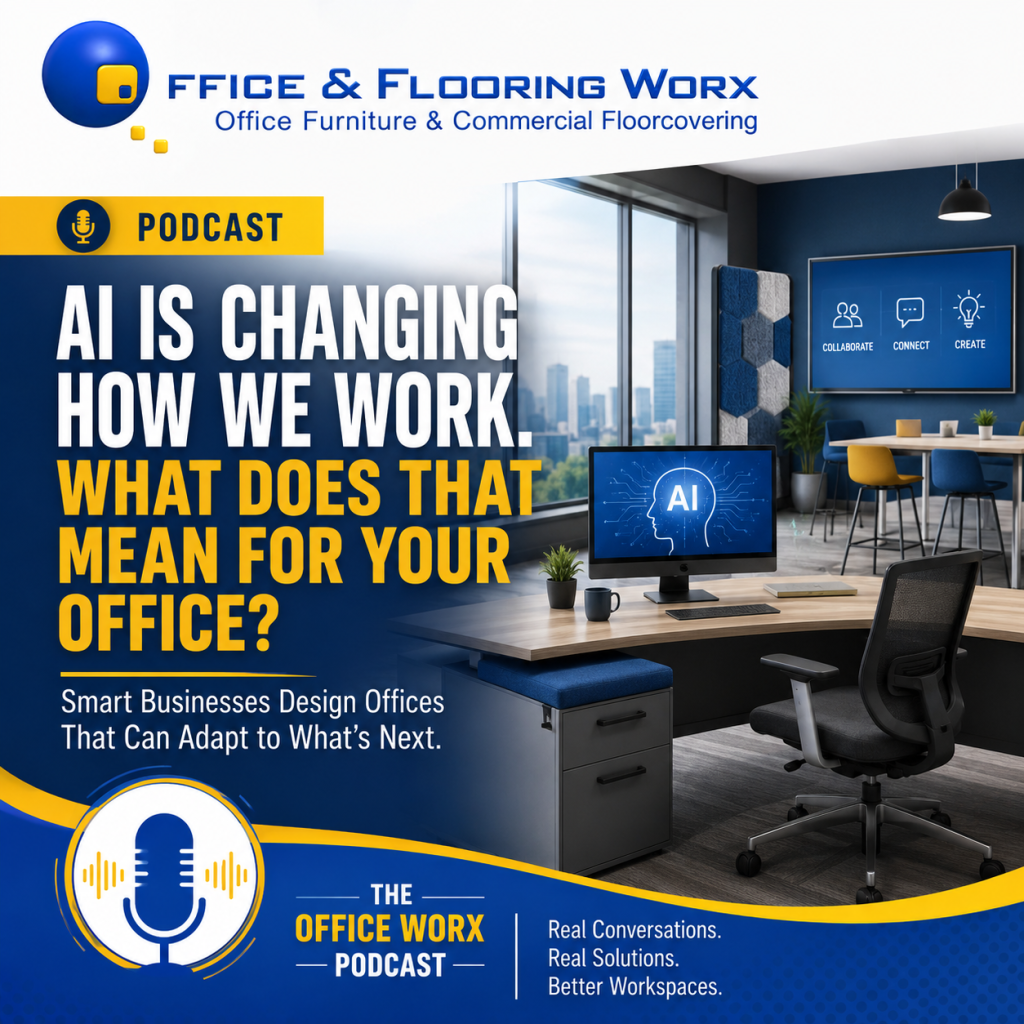
Artificial intelligence is changing business faster than almost anyone predicted, AI in the workplace illustrates the trend.
Companies are using AI to assist with writing, research, customer service, data analysis, scheduling, marketing, accounting, presentations, communications, and countless repetitive tasks that once consumed hours of an employee’s workday.
The other side of AI in the workplace
But there is another side of AI in the workplace conversation that receives far less attention.
What happens to the physical workplace when AI in the workplace starts changing the work itself?
Businesses invest heavily in technology, including AI in the workplace, while many employees work in offices designed for older practices.
Technology has changed.
Communication has changed.
Customers have changed.
Employee expectations have changed.
The workday has changed.
Yet the physical office often remains almost exactly the same.
Rows of desks. Assigned workstations. A handful of private offices. One large conference room. Maybe a break room and reception area.
That setup may still work perfectly well for some businesses.
For others, however, there may be a growing disconnect between how an office was designed and how employees actually work today.
And as AI becomes a larger part of everyday business, that disconnect could become even more noticeable.
The question Tampa Bay business owners should be asking isn’t:
“Do we need an AI office?”
You don’t.
The better question is:
If the work is changing, should the workplace change with it?
AI Isn’t Just Changing Technology
Most conversations about artificial intelligence begin with software.
What can AI automate?
How much time can it save?
Can it write an email?
Can it summarize a document?
Can it analyze information?
Can it help create marketing materials?
Can it streamline administrative work?
Those are worthwhile questions.
But businesses should also consider what happens after employees begin saving time on those activities.
Imagine an employee who previously spent two hours gathering information for a report.
AI may help that employee develop a starting point much faster.
Another employee might once have spent an hour preparing the first draft of an internal document.
AI may shorten that process.
A manager who previously spent considerable time organizing information, summarizing documents, or reviewing repetitive data may now have tools that assist with those tasks.
That doesn’t automatically mean those employees disappear.
It can mean their time gets redistributed.
And where that time goes may matter tremendously to workplace design.
Employees may spend more time on:
- Decision-making
- Strategy
- Problem solving
- Creativity
- Collaboration
- Training
- Client relationships
- Communication
- Project reviews
- Planning
Many of those activities require a different environment than repetitive individual desk work.
That is where office design enters the AI conversation.
Your Office May Have Been Designed for a Different Kind of Work
Walk around a traditional office and you’ll probably see a familiar pattern.
Individual desks.
Private offices.
One conference room.
A reception area.
Possibly a break room.
Historically, that arrangement made perfect sense.
Employees arrived in the morning, went to an assigned workspace, completed mostly individual tasks throughout the day, attended an occasional meeting, and returned to their desks.
But many modern workdays aren’t nearly that predictable.
Someone might begin the morning working independently.
An hour later, they may meet with two coworkers to review a project.
Then they join a video conference.
Later, they need somewhere quiet to concentrate.
After lunch, they might meet with a client.
Then several people gather around a screen to discuss a proposal.
By the end of the day, the same employee may have performed five or six completely different types of work.
The problem isn’t necessarily the furniture.
The problem is designing an entire office around the assumption that every employee will perform essentially the same activity, in the same place, all day long.
Modern work is becoming more fluid.
The workplace needs to be capable of supporting that movement.
Does AI Mean the Desk Is Going Away?
No.
Despite years of predictions about the death of the traditional office, employees still need comfortable places to work.
Desks still matter.
Workstations still matter.
Private offices still matter.
Ergonomic chairs definitely still matter.
The mistake is assuming the desk must be the center of every activity happening throughout the workday.
A more flexible workplace may include environments designed for different purposes.
Employees may need places for:
- Focused individual work
- Small-group collaboration
- Larger meetings
- Training
- Video calls
- Client conversations
- Private discussions
- Informal conversations
- Project planning
- Creative work
Instead of thinking about the office as one large room filled with furniture, businesses can begin thinking about it as a collection of environments designed to help people accomplish different types of work.
AI may accelerate that shift.
If technology handles more routine tasks, the value of the physical workplace may increasingly come from things technology cannot completely replace:
Human interaction.
Relationships.
Trust.
Creativity.
Culture.
Mentoring.
Collaboration.
Those activities deserve environments designed around them.
Take Another Look at the Conference Room
Here is a simple exercise.
Think about the largest conference room in your office.
How often is it actually occupied?
Perhaps twelve people gather around the table once or twice each month.
But throughout an average week, how many smaller conversations happen?
Two employees need somewhere to review a project.
Three people want to brainstorm.
A manager needs to conduct a one-on-one meeting.
Someone needs privacy for a video conference.
A salesperson needs to meet with a customer.
A small team needs to review something on a screen.
Those conversations may happen every day.
Yet many offices devote considerable square footage to one large meeting room while employees struggle to find smaller spaces for the interactions that happen much more frequently.
The solution doesn’t necessarily mean eliminating the large conference room.
It means examining whether your office provides the right-sized spaces for the work actually happening inside it.
Perhaps you need:
- A small collaboration area
- A two- to four-person meeting space
- A video-call room
- A flexible training area
- Movable partitions
- A project table
- Furniture that creates separation without permanent construction
The future of office planning may not be about having more square footage.
It may be about using the square footage you already have more intelligently.
Don’t Redesign Your Office for AI
This distinction is important.
Businesses should not renovate their offices simply because artificial intelligence is the newest trend.
Nobody needs to walk into the office Monday morning and announce:
“ChatGPT is popular. Throw away the desks.”
That completely misses the point.
Instead, examine what has actually changed about your business.
AI may be one factor.
There may be many others:
Hybrid schedules.
New employees.
Fewer employees.
Department changes.
More video conferences.
Less paperwork.
Different customer expectations.
More collaboration.
New technology.
Generational changes in the workforce.
Business growth.
Business consolidation.
New services.
New locations.
Changes in management style.
All of those things can affect how the physical workplace should function.
The goal isn’t to design an office around a technology trend.
The goal is to design an office around how your business really operates.
The Five-Year Furniture Question
Before making a significant office furniture purchase, ask yourself one question:
Will this furniture still make sense if our business changes?
It sounds simple.
But it can completely change the way you evaluate furniture.
Your company probably won’t look exactly the same five years from now.
You may have more employees.
You may have fewer employees.
Departments could change.
Hybrid schedules could expand or contract.
You may need additional collaboration space.
Your floor plan could change.
You could move.
You could acquire another business.
You might open another location.
Technology could dramatically change how certain jobs are performed.
That means flexibility has real value.
Before buying furniture, ask:
Can these workstations be reconfigured?
Can components be moved?
Can the system expand?
Can furniture be reused somewhere else?
Could today’s workstation become part of tomorrow’s layout?
Can your conference space serve more than one purpose?
Can the office change without forcing you to replace everything?
Adaptable furniture doesn’t merely give you furniture.
It gives your business options.
And options become increasingly valuable when nobody can predict exactly how work will evolve over the next several years.
Stop Asking Only “How Many Desks Do We Need?”
One of the most useful changes a business owner can make is changing the first question they ask during office planning.
Instead of starting with:
“How many desks do we need?”
Start with:
“What types of work do our employees need to do?”
Those questions lead to very different workplaces.
Imagine a company with 30 employees.
The obvious answer might be to purchase 30 similar workstations and arrange them throughout the space.
But what if the employees’ actual work requires something different?
Perhaps the company needs:
20 primary workstations.
Two smaller collaboration areas.
A private meeting room.
A video conference area.
A flexible training space.
A comfortable client meeting area.
A few touchdown stations.
A quiet place where someone can concentrate.
The exact combination will be different for every organization.
That is precisely why space planning matters.
You need to understand the work before deciding what should go into the space.
Technology Is Becoming Part of the Furniture
Technology used to be something employees brought to their workspace.
Today, it is increasingly part of the workspace itself.
Think about what modern employees use throughout an average day.
Laptops.
Multiple monitors.
Phones.
Video conferencing systems.
Large displays.
Wireless devices.
Charging equipment.
Collaboration tools.
Adjustable desks.
Presentation screens.
Technology is everywhere.
And furniture needs to support it.
A beautiful conference table isn’t particularly functional if nobody can easily access power during a meeting.
A workstation with poor cable management can quickly become cluttered.
A collaboration area without a convenient way to display information may limit what employees can accomplish there.
A training space may need to support presentations one day and group work the next.
This doesn’t mean every office needs the newest or most expensive technology.
It means the physical environment should support the technology your employees already use.
Good furniture planning increasingly requires thinking about technology from the beginning rather than trying to add it later.
AI Could Make the Physical Office More Important
At first, this may sound backward.
If technology makes it easier for employees to work from anywhere, wouldn’t the physical office become less important?
Perhaps not.
It may become more intentional.
If employees can complete many independent tasks from home, a coffee shop, an airport, or almost anywhere else, businesses need a better reason for asking people to come together physically.
The office becomes less about providing a desk and more about creating environments where being together adds value.
Employees may come to the office for:
Collaboration.
Training.
Mentoring.
Strategy.
Client meetings.
Problem solving.
Creative work.
Team building.
Relationship building.
Culture.
Those activities put greater importance on the quality of the physical environment.
If people are going to gather together, the office should make those interactions easier.
That is a very different philosophy than simply fitting the maximum possible number of workstations into a floor plan.
Five Questions Every Business Owner Should Ask About Their Office
You don’t need to remodel your office tomorrow.
You don’t necessarily need new furniture.
You don’t need an expensive workplace study.
Start by simply walking through your existing workspace and observing how it is being used.
Ask these five questions.
1. Where are people actually working?
Not where the original floor plan says they’re supposed to work.
Where do people really spend their time?
Are employees constantly gathering somewhere that wasn’t intended as a collaboration area?
Do people leave their desks to find somewhere quieter?
Do certain workstations sit empty?
Actual behavior can tell you a great deal about whether the office supports your team.
2. Which spaces are constantly used—and which ones sit empty?
Look for patterns.
Perhaps one small meeting room is always booked while the large conference room remains empty.
Maybe your reception area occupies significant square footage but receives very few visitors.
Perhaps employees gather around a table that was never intended to be a meeting area.
Unused space isn’t necessarily bad.
But it may reveal opportunities.
3. What activities are difficult in the current layout?
Can employees collaborate easily?
Can someone take a private video call?
Is there somewhere to meet with a customer?
Can employees concentrate when necessary?
Can small teams work together without disturbing everyone else?
Friction usually reveals where the workspace could improve.
4. What has changed about the business during the last three years?
Think beyond headcount.
What changed about:
Technology?
Customers?
Departments?
Services?
Work processes?
Employee schedules?
Communication?
Management?
Your office should reflect the business you operate today—not necessarily the one you operated when the furniture was purchased.
5. Can the office change when the business changes again?
This may be the most important question.
Because change is almost guaranteed.
Your company doesn’t have to perfectly predict the future.
It simply needs a workplace flexible enough to respond to it.
Your Office Should Be a Business Asset
An office is not simply a room where desks happen to be located.
It is part of your business infrastructure.
Your workplace affects:
How employees communicate.
How easily teams collaborate.
How customers perceive your company.
How efficiently you use square footage.
How comfortably employees work.
How easily departments interact.
How technology is used.
How quickly your company can adapt.
That is why an office furniture conversation shouldn’t always begin with:
“Which desk do you like?”
A better starting point is:
“What are you trying to accomplish in this space?”
Once you understand that, furniture selection becomes much easier.
The desk, chair, workstation, conference table, flooring, and storage all become tools serving a larger objective.
Designing a Tampa Bay Office That Can Adapt
Businesses throughout Tampa Bay are changing.
Some are growing.
Some are consolidating.
Some are embracing hybrid schedules.
Some are bringing employees back into the office.
Others are changing how departments interact.
And almost every organization is experimenting with new technology.
There is no single office layout that works for all of them.
That’s why successful workplace planning isn’t about chasing design trends.
It’s about creating a workplace that fits the organization inside it.
At Office & Flooring Worx, we help Tampa Bay businesses look beyond individual furniture pieces and consider how the entire workspace functions.
That can include:
- Office space planning
- Workstations
- Private offices
- Conference rooms
- Reception areas
- Ergonomic seating
- Furniture reconfiguration
- Installation
- Commercial flooring
- Workplace furniture selection
- Planning for future changes
The goal isn’t simply to fill an empty room with desks and chairs.
The goal is to make the room work for the business.
The Workplace Will Keep Changing
Nobody knows exactly what artificial intelligence will do to the workplace five years from now.
Some predictions will turn out to be accurate.
Others won’t.
New technologies will emerge.
Businesses will adopt them at different speeds.
Job responsibilities will evolve.
Employee expectations will continue changing.
But there is one prediction we can make with reasonable confidence:
Your business probably won’t operate exactly the same way five years from now as it does today.
So when you’re planning your office, don’t design exclusively for yesterday.
And don’t design exclusively around today’s newest technology trend.
Design around your people.
Design around your business.
Design around the work actually happening.
And when you invest in office furniture, ask one final question:
“Will this still work when our business changes?”
Because the best office isn’t necessarily the one that looks the most impressive on the day it is installed.
It’s the one that continues working for your business years later.
Is Your Office Keeping Up With Your Business?
If your Tampa Bay business has changed but your workspace hasn’t, it may be time to take another look at how you’re using your space.
Office & Flooring Worx can help you evaluate your existing layout, plan for changing workplace needs, select the right furniture, reconfigure existing systems, and create a workplace built around the way your company actually works.
Your business doesn’t have to fit your office.
Your office should fit your business.
Check Out Our Top Manufactures
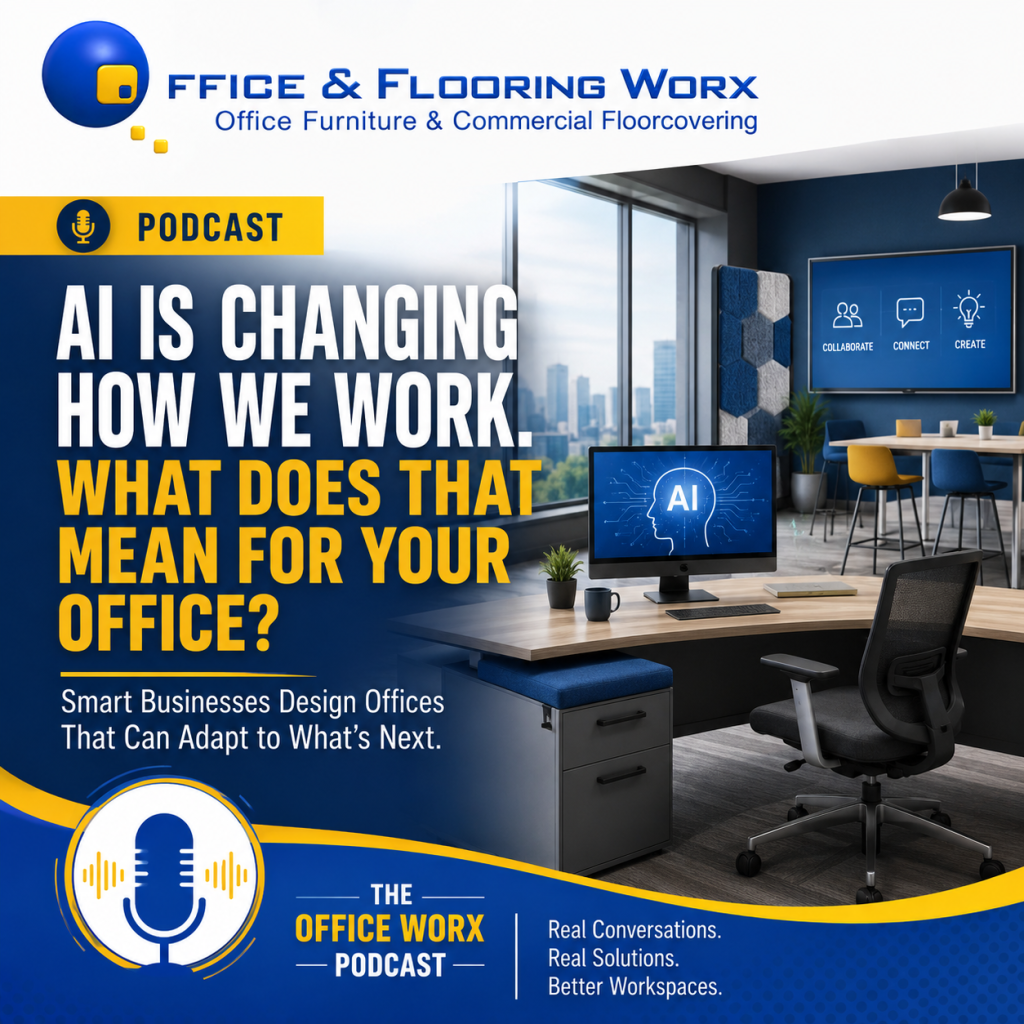
We invite you to listen to our newest Podcast Episode: AI Is Changing How We Work. What Does That Mean for Your Office? #28
Ready for an Office That Works the Way Your Business Does?
Your business is changing. Your technology is changing. The way your employees work is changing.
Your office should be able to change with you.
Whether you’re planning a new office, re-configuring an existing space, updating furniture, or simply wondering if your current layout is still working, Office & Flooring Worx can help you find a smarter way forward.
We’ll look at how your space is actually being used and help you create a workplace built for productivity, collaboration, flexibility, and future growth.
Let’s make your office work harder for your business.
Contact Office & Flooring Worx today to start the conversation.
